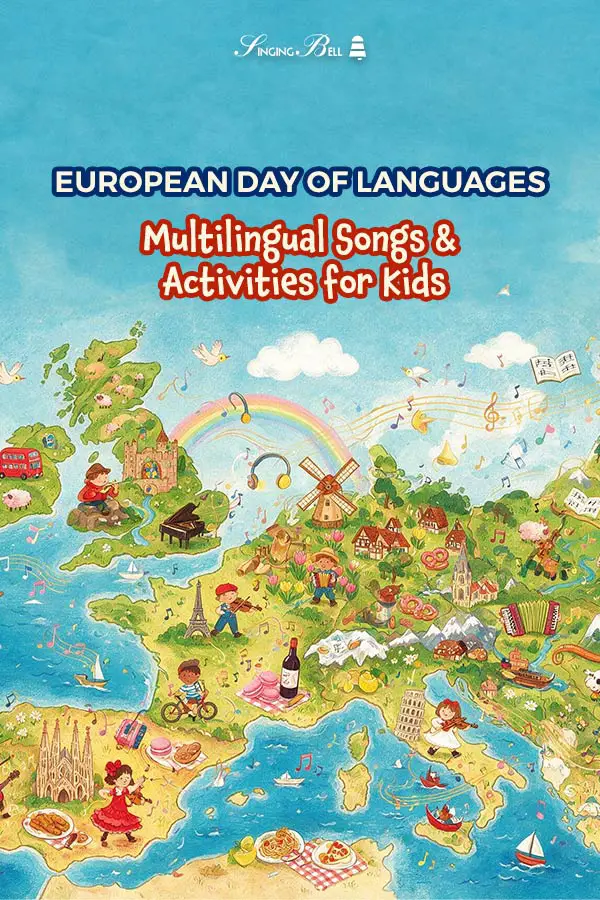
Every September, the European Day of Languages invites kids
to explore sounds, words and songs from across the continent.

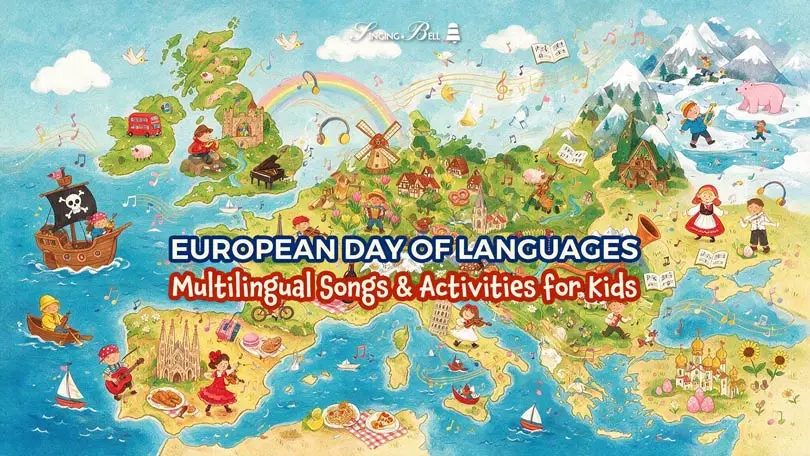
Every September, children across Europe get a fun excuse to try out a new word. The 26th marks the European Day of Languages, a celebration of the hundreds of languages spoken across the continent — from the ones you’ll hear in almost every classroom, like English, French, German, Spanish and Italian, to the smaller regional and minority languages that give each corner of Europe its own voice. It’s a day built for curiosity rather than fluency: nobody expects a five-year-old to conjugate French verbs, but almost any child can learn to say “hello” a new way, sing a familiar tune with different words, or find a country on a map and wonder what people there sound like.
For families and teachers looking for an easy way to mark the day, music is one of the simplest doors in. A song your child already knows and loves — think “Frère Jacques” or “Head, Shoulders, Knees and Toes” — becomes an instant language lesson the moment you swap in new words, because the melody carries the meaning even when the vocabulary doesn’t.
In this post, we’ll walk through why exposing kids to multiple languages matters, share songs and activities that make it easy, and — to make the day even more hands-on — offer a free printable to bring it all together.
1.
What Is the European Day of Languages?
The European Day of Languages is celebrated every year on 26 September. It is a day to celebrate the many different languages spoken across Europe and to encourage children and adults to discover new languages and cultures.
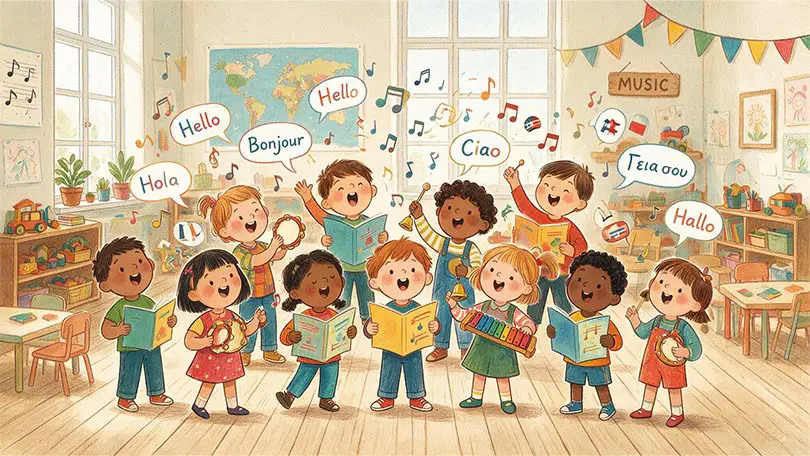
There are hundreds of languages spoken in Europe, from widely spoken languages such as English, French, German, Spanish and Italian to smaller regional and minority languages. The European Day of Languages is a great opportunity for children to discover that the same idea — a greeting, a song, a number or even a nursery rhyme — can sound very different in another language.
And you don’t need to be fluent in another language to join in! Singing songs, learning a few simple words and playing language games are easy and enjoyable ways for children to explore other languages.
2.
Why Does Learning Multiple Languages Matter for Kids?
Introducing children to different languages from an early age can be a fun way to support communication, listening and memory skills. Switching between different sounds and words encourages children to pay attention to how languages work and can help them become more comfortable with unfamiliar sounds.
Languages also provide a window into other cultures. Learning how to say hello, count to ten or sing a familiar song in another language can help children become curious about people and places beyond their own surroundings.
And perhaps most importantly, language learning doesn’t have to feel like a lesson. Songs, rhymes, games and repetition make it easy for children to experiment with new words while simply having fun.
3.
Songs to Sing in Different Languages
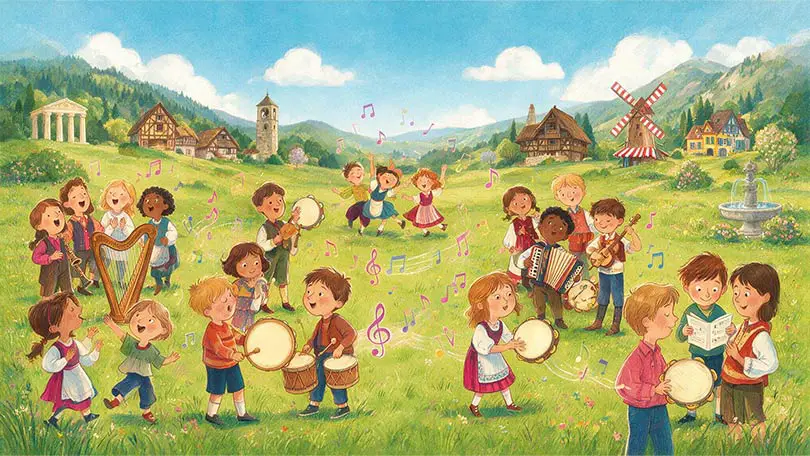
Music is one of the easiest ways to introduce children to another language. A familiar melody gives them something they already know, while the new words encourage them to listen carefully and try different sounds.
Frère Jacques
One of the best-known examples is “Frère Jacques,” the traditional French children’s song. Many children already know its English counterpart, “Are You Sleeping?”, making it a particularly easy song to introduce in two languages. The German version “Bruder Jakob” is also available if you’re introducing three languages.
You can start by singing the English version and then introduce the French version. Children will quickly notice that the melody stays the same even though the words sound completely different.
Frère Jacques is also perfect for a classroom sing-along because it can be sung as a round. Once children know the melody, divide the class into two groups and have the second group begin after the first.
Head, Shoulders, Knees and Toes
“Head, Shoulders, Knees and Toes” is another excellent multilingual activity because the movements make the meaning of the words easy to understand.
Try singing it in English first, then introduce a Spanish or French version. Children can follow the same actions even when they don’t know every word yet. This makes the activity particularly suitable for beginners.
If You’re Happy and You Know it
“If You’re Happy and You Know It” is a natural fit for multilingual singing because the actions do most of the work. Clapping, stamping and shouting “hooray” mean the same thing in any language, so children can follow along and join in even before they know the words.
Start with the English version to get everyone clapping and moving, then try it in Spanish or French. Since the fun of the song comes from the actions rather than the lyrics, it’s an easy way for beginners to feel successful right away — and a great excuse to add a few silly new movements for each language.
Twinkle, Twinkle, Little Star
“Twinkle, Twinkle, Little Star” is one of the most recognizable tunes for young children, which makes it an ideal song for hearing how the same melody can sound in different languages. Because the words are simple and repetitive, kids can pick up new vocabulary quickly without losing the tune they already love.
Sing it in English first, then introduce the Spanish or French version alongside it. Children often enjoy spotting familiar sounds between versions — a nice way to show them that different languages can still share the same rhythm and feeling.
Other Familiar Songs
You can use the same approach with other traditional children’s songs. For example:
- “The Wheels on the Bus” — learn a few verses in another language and keep the actions the same.
- “Happy Birthday” — sing it in several languages and compare how the words change.
- Counting songs — learn numbers in another language while singing or playing a counting game.
The goal isn’t to memorize a whole song perfectly. Even learning a chorus, a few words or the numbers from one to ten can be a fun introduction to another language.
4.
4 Simple Ways to Celebrate the European Day of Languages
You don’t need elaborate resources or a full language lesson to celebrate. Here are five simple activities that can work in a classroom, music lesson or at home.
1. Have a “Greeting of the Day”
Choose a different language each day — or several languages on 26 September — and teach children how to say hello.
Write the word on the board and practice saying it together. You could try:
- Hello — English
- Bonjour — French
- Hola — Spanish
- Hallo — German
- Ciao — Italian
- Γεια σου — Greek
Encourage children to use the greeting throughout the day.
2. Find the Languages on a Map
Put a map of Europe on the wall and choose several languages to explore.
Ask children:
“Where do people speak French?”
“Where might we hear Spanish?”
“What languages are spoken near where we live?”
You can add small flags, language names or pictures to the map. For younger children, simply finding a country and saying its name can be enough.
3. Make a Language Word Wall
Create a classroom display with a few simple words in different languages.
Choose everyday words such as:
hello · goodbye · thank you · yes · no · one · two · friend
Let children contribute words they know or ask family members to provide a word in another language. Over time, the wall can become a colorful collection of languages from around the world.
4. Make a Multilingual Music Game
Turn language learning into a game using music.
For example, play a song and stop it at random. When the music stops, choose a language and ask the children to say a particular word or number in that language.
You could also give each language a different movement — clap for French, stamp for Spanish, jump for German, for example — and call out languages while the children perform the correct action.
Hello Around Europe – Free Printable PDF about the European Day of Languages
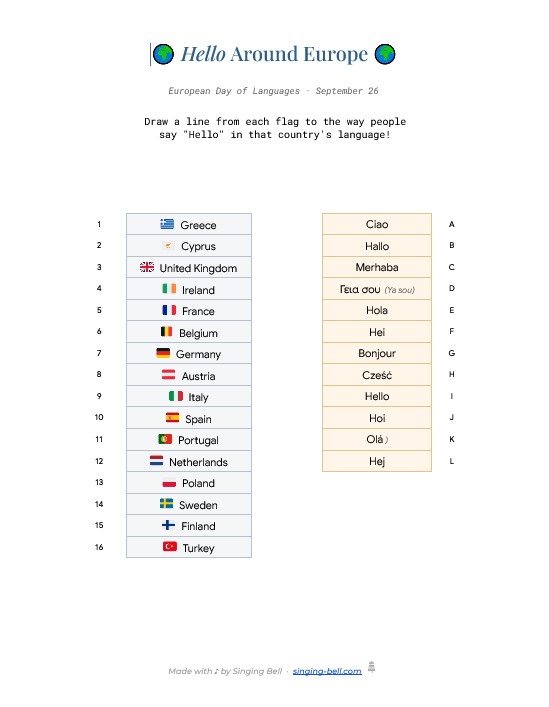
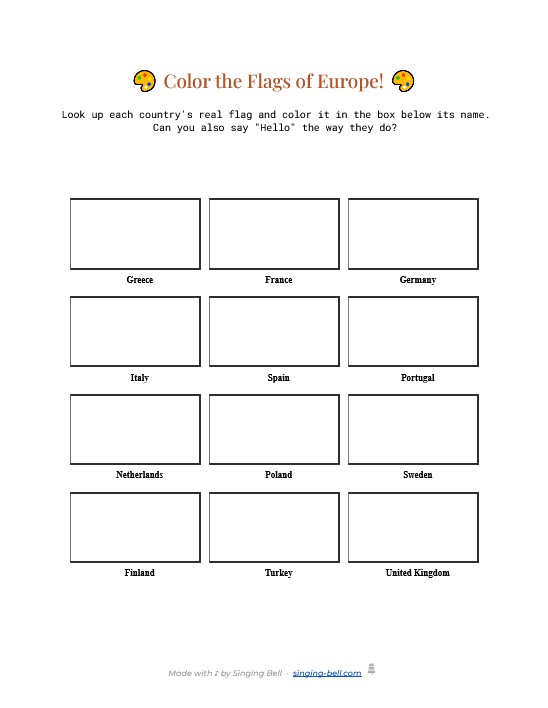
To make the celebration hands-on, we’ve put together a two-page printable just for this occasion: “Hello Around Europe.”
On the first page, kids get a matching game — 16 flags from across Europe on one side, and 12 different ways to say “Hello” on the other. Since several countries share a language (like Greece and Cyprus, or Germany and Austria), it’s a fun way to show kids that borders and languages don’t always line up the way we expect!
The second page flips into a coloring activity: blank flag outlines for 12 countries, inviting children to research the real colors and patterns themselves before filling them in — turning a coloring page into a little geography lesson too.
We’ve also included a teacher’s copy with the answer key for classroom use.
It’s perfect for classrooms, homeschool language lessons, or a rainy afternoon at home.
PDF download

Celebrate Languages Through Music
The European Day of Languages is a wonderful reminder that children don’t have to speak a language fluently to enjoy it. A song can introduce them to new sounds, new words and a new culture in just a few minutes.
So choose a familiar song, learn a few new words, find the country on a map — and sing together!

Liked it? Pin it!
Did you like this post? Rate it!
 (1 vote(s), average: 5.00 out of 5)
 Loading...
Best School Event Ideas that Students (and Teachers) Will Love – Activity Calendar
Activities by month
You may also like:
Creators, Here Are 8 Music Licenses for your YouTube Videos